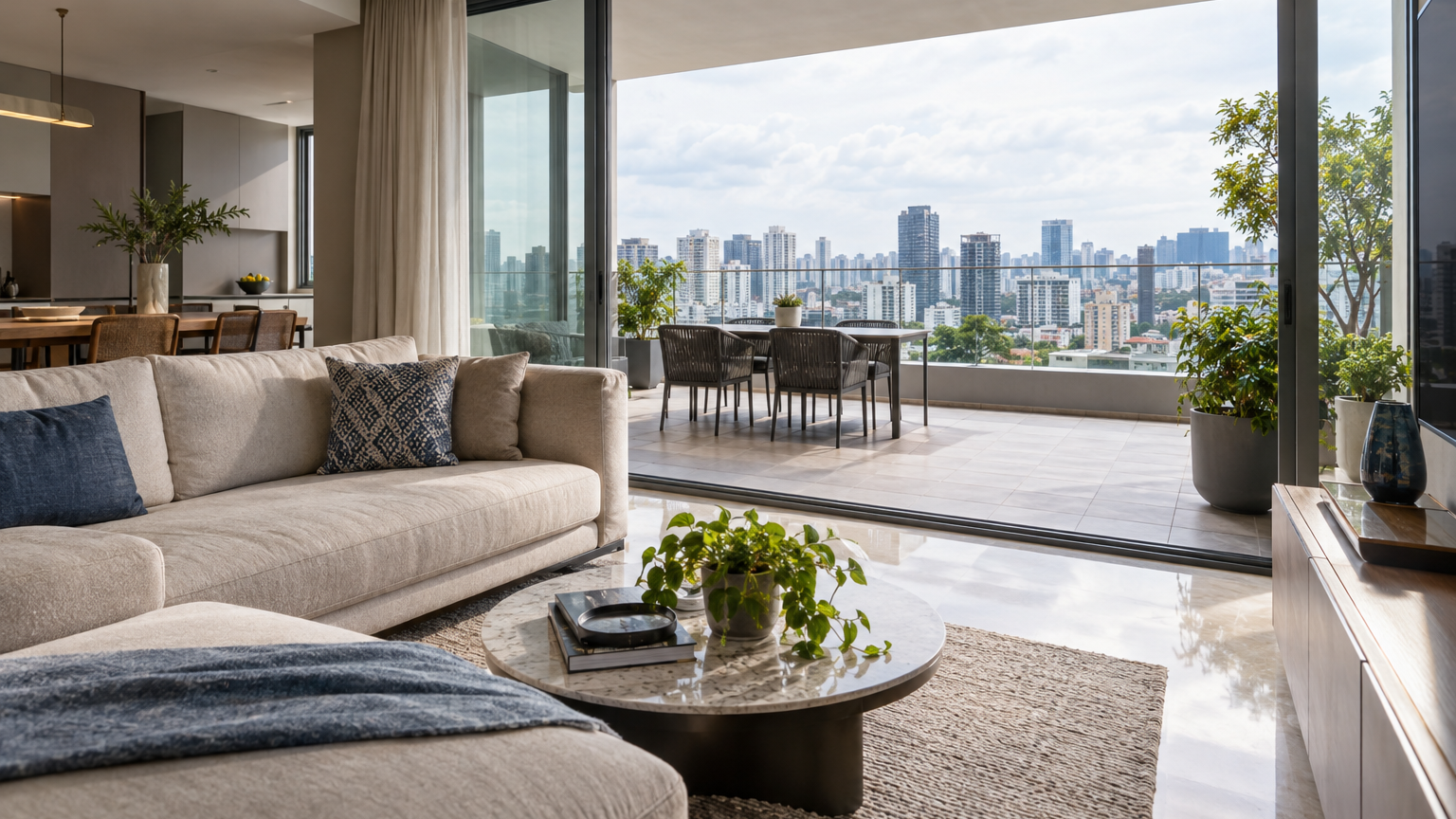
A 30-year-old medical professional and his wife paid S$2.1 million for a new freehold two-bedroom home near Holland Village in 2023. Identified publicly only by the pseudonym Joshua, he liked the location, the newness and the ability to make progressive payments as construction advanced.
His choice now sits beside a surprising wider finding: Singapore resale homes recorded higher median returns than new units, whose buyers had entered at higher prices. For penthouse hunters, the useful lesson is not simply “buy resale”. It is to examine what the purchase price actually buys—especially when a substantial part of the stated floor area is outdoors.
Why the entry price matters
A realised return compares what a home sold for with what its owner originally paid. That makes the entry price crucial: two broadly comparable homes can rise to a similar eventual value while producing different percentage returns because one buyer started from a higher base.
Consider a purely illustrative example. If one home rises from S$2 million to S$2.2 million, its gross gain is 10 per cent. Another rising from S$1.8 million to the same S$2.2 million records a gross gain of about 22 per cent. The eventual selling price is identical; the starting points are not.
That arithmetic helps explain how resale homes could record the stronger median result even when buyers remain attracted to brand-new units. A median is the middle observation after results are placed in order. It is not the return every owner earned, nor is it a forecast for the next penthouse purchase.
There is also a material evidence limit. The accessible report establishes the direction of the finding and links slimmer new-unit gains to higher purchase prices, but it does not disclose the median percentages, sample size, holding periods or cost treatment. There is no published penthouse subset in the available material, so applying the result directly to every top-floor home would go beyond the evidence.
A penthouse’s floor area needs unpacking
Penthouse comparisons get complicated because the advertised area may combine spaces that serve very different purposes. An enclosed bedroom, a double-volume void, a balcony and an open roof terrace should not automatically be treated as one uniform block of living space.
Start by marking the floor plan into three practical categories:
- Enclosed internal area: bedrooms, living and dining areas, kitchen, bathrooms and internal circulation.
- Sheltered or semi-outdoor area: covered balconies, verandas or transitional spaces.
- Exposed outdoor area: open terraces, roof decks or private outdoor areas subject to sun and rain.
This is not an argument that outdoor space has little value. A usable terrace can transform how a household entertains, gardens or spends evenings at home. But its personal value depends on whether the household will actually use it, while the purchase price still covers the entire strata area.
That distinction can change how two asking prices look. A larger resale penthouse may offer more total floor area but less enclosed space than a smaller new unit. Conversely, an older home may provide broad internal rooms and a practical terrace, while a newer one uses more of its footprint for circulation or visual drama. The total square footage alone will not resolve that comparison.
Compare the layout before the price per square foot
Price per square foot is calculated by dividing the price by the stated floor area. It is convenient, but it becomes blunt when one penthouse has considerably more exposed outdoor space than another.
Suppose two homes have the same total area and asking price. Home A places most of that area indoors; Home B allocates a large share to an open roof terrace. Their headline price per square foot will be identical even though their day-to-day living arrangements are quite different.
A more revealing comparison is to place the floor plans side by side and ask:
- How much space is enclosed and comfortably usable throughout the day?
- Can the terrace be reached directly from the main living area, or only through a bedroom or staircase?
- Does the layout sacrifice indoor rooms to create the headline total area?
- Are there awkward corners, voids or circulation areas that inflate size without adding much practical use?
Buyers need not invent an arbitrary “discount” for terrace space. The available evidence supports no universal conversion rate. The aim is simply to avoid assuming that every square foot provides the same utility.
Resale records also need careful reading
Singapore’s official transaction search separates developer sales from resale and sub-sale records. New-sale records from 25 May 2015 are based on Options to Purchase issued by developers; resale and sub-sale records are based on caveats lodged with the Singapore Land Authority.
A caveat is a legal notice recording a purchaser’s interest in a property. Lodging one is not compulsory, so some completed resale deals may be absent from the public results. The search also covers transactions with caveats lodged or developer Options to Purchase issued within the preceding 60 months.
These definitions matter when checking the purchase history of a particular penthouse. A public search can help identify recorded deals, but an apparent gap does not necessarily mean the unit never changed hands. It also does not reveal renovation spending, financing costs, maintenance contributions or the condition in which the home was bought and sold.
URA’s broader private-home price indices take account of attributes including a property’s age and unit size through a statistical method known as stratified hedonic regression. That makes the indices useful for tracking broad price movements, but they are not a record of the realised return earned on the same penthouse between purchase and resale.
The older penthouse has another layer: upkeep
A resale penthouse offers something a new launch cannot: an existing space that can be inspected in its present form. That creates an opportunity to look beyond staged furniture and ask how the top-floor areas function after exposure to Singapore’s weather.
For a terrace-heavy home, examine the threshold between indoors and outdoors, drainage points, signs of ponding or staining, the condition of surface finishes and the route used for maintenance access. Ask who is responsible for each area and proposed repair rather than assuming every roof-adjacent element belongs solely to either the owner or the management corporation.
Monthly maintenance contributions also deserve attention, but the current amount is only a starting point. Buyers can review available management records and ask about significant planned works affecting lifts, façades, roofs or shared facilities. A penthouse that depends on private lift access should also be assessed as a home during lift servicing or disruption, not only when everything works perfectly.
None of these questions establishes that an older penthouse will be expensive to maintain. They make the comparison fairer. A lower resale entry price may leave room for refurbishment, but that room is useful only after the buyer understands the layout and likely work involved.
The higher reported resale median therefore offers a starting explanation, not a buying verdict. For penthouse buyers, the sharper comparison is between the price paid, the enclosed space genuinely used, the outdoor area genuinely valued and the upkeep taken on. Before comparing two headline prices, separate the rooms from the roof terrace on both floor plans.